
Journal · 26/09/2026 · 4 min read
The keeper: on Ubrus
A photographer wakes from a two-and-a-half-year coma speaking Hebrew and Latin. Seven lives, one piece of silk as fine as a cobweb, and a road that leads from Paris to Jerusalem.
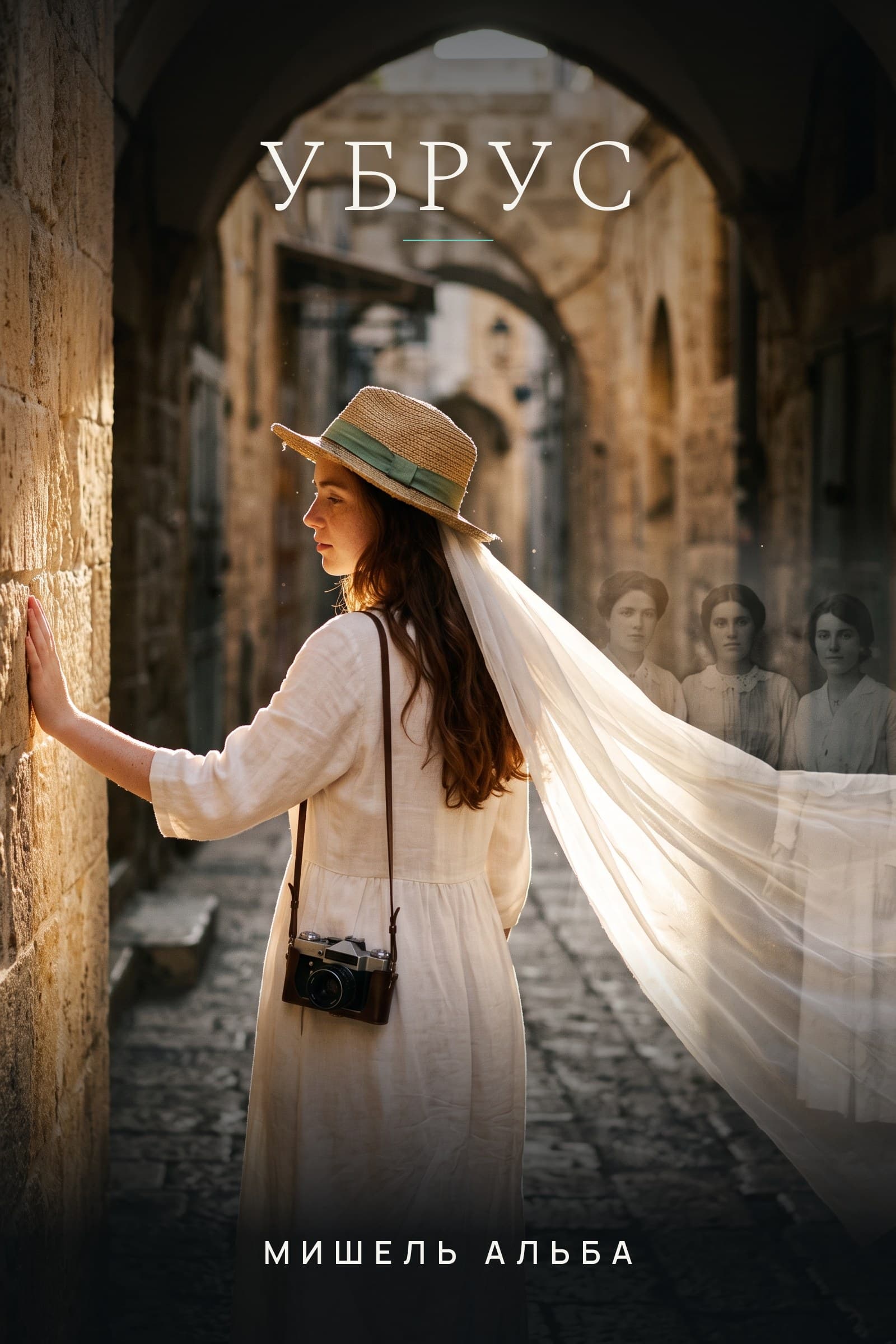
Ubrus is the longest of the six novels and, for many readers, the most moving. It begins with a woman who is barely alive and ends two thousand years before her birth.
A photographer in a coma
«Véronique had been living in the coma that had walled her in for almost two and a half years.»
Véronique Lassar is a Paris photographer of about twenty-five, the kind of person whose camera is always with her — «is it your tail, or are you its?» her sister teases. One rainy night, on a bridge over the Seine, on her way to an urgent assignment, her car is rammed by an oncoming one and goes into the river. At the hospital she is declared dead before she is revived.
Since then the doctors have called her «vegetative». Only her sister Suzanne, nine years older and her only family since their parents were killed one Christmas when Véronique was six, refuses to let her go. And so Suzanne brings in a last hope from Israel.
Nathan Versailles
He is one of the most memorable characters in all six books: a slightly heavy man with shoulder-length wavy hair, an Oxford graduate who was going to be a neurosurgeon and speaks twelve languages. His own family, including a three-month-old girl named Gila, died in Paris during the Occupation. He can lift a pencil into the air with a look. When Suzanne asks why he gave up surgery, he answers:
«It means, dear Suzanne, that I looked to the other side of life.»
At the first session Véronique's eyes begin to move under her eyelids. Versailles goes into her «fortress» and talks to her. «Come again.» «Yes. Soon.» At the decisive session she relives the crash on the bridge and walks into a shining, silvery-white tunnel. Versailles risks himself to bring her back — and she wakes up.
Waking up as someone else
She wakes up changed. She speaks Hebrew without an accent and Latin with a Tuscan lilt. Looking at a newspaper photograph in which everyone else sees a shop window full of Easter china, she sees a girl — herself. Her memory, Versailles explains, has woken up with her, «and for some reason it has started counting from the end towards the beginning».
He takes her to his home in a moshav near Jerusalem — lemon trees, a swimming pool, a housekeeper named Shoshi who feeds everyone chicken and honey strudel. And there, session by session, Véronique begins to go back.
Seven lives, backwards
The structure of the novel follows her memory. Its parts are named after women, and each is a life. Among them:
Gemma, twenty-one, on 17 January 1811, walking through a winter night to a convent of Poor Clares — and finding a dying Franciscan monk with a box wrapped in sacking.
Marzia, in Italy at the beginning of the seventeenth century, the daughter of old Amato, who had hidden something precious — and hunted after his death.
Luigia, in Rome in 1527, during the sack of the city, hiding in a niche by a statue of Saint Berenice in the old St Peter's.
Claudia, at the beginning of the twelfth century, carrying a parcel to a vicar.
Julia, pregnant, near a great cathedral of Saint Sophia, in days when no one wants to cross the emperor's path.
And finally Berenice, in Jerusalem in the first century, in a street where a condemned man is being led with his cross.
In every life she does the same thing. She saves a piece of silk «incredibly fine, like a cobweb». The novel's title is the old word for it: ubrus, a cloth.
The road to Jerusalem
What begins as hypnotherapy stops being only memory. Bruises from the past stay on Véronique's body. And one day, by the stones of the Old City — among the stalls of oriental sweets, a tired, shabby camel, the crowd moving towards the Church of the Holy Sepulchre and the Western Wall — she crosses over while fully awake.
The Jerusalem of the novel is written with real love: the night city seen from the road «like a mirror reflection of the night sky sparkling above it with millions of stars», Ben Yehuda Street, Rehavia, a falafel stand where someone protests that he «doesn't understand hummus without cumin».
What the book is about
Ubrus is about life and death, and about the strange time in between — coma as a place where «tomorrow, today and yesterday» have run together. It is about two sisters. It is about forgiveness: the driver of the car on the bridge, a doctor named Luc, has been looking for Véronique to ask her pardon. And it is about a soul that keeps one treasure across seven lives.
Near the end, the qualities a person needs in this world are counted out one by one:
«This one is the ability to keep your mind. This one is endurance against pain. This one is not losing the wish to live. And this one... to go on believing in good.»
It is the brightest of the six books — a novel about light that, as one of its characters says, is within us.