Journal · 29/09/2026 · 3 min read
Five centuries of one fire: on The Inquisitor
A man who burns in his sleep, a scientist who studies memory, and Milan in 1484. On the darkest of the six novels — and on why it still does not end in the dark.
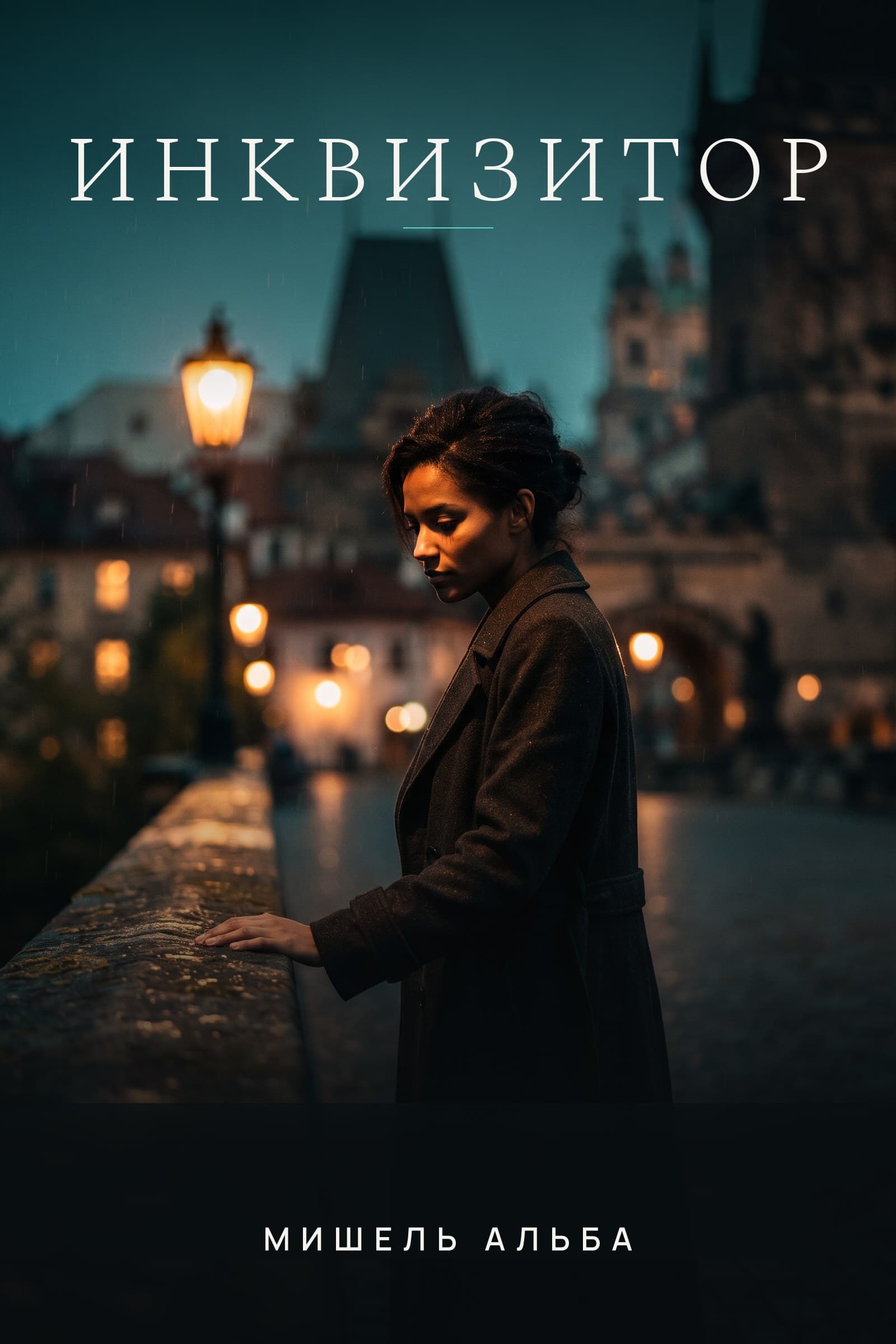
The Inquisitor opens like a thriller. Late at night Doménik Fallo comes home to Florence after a day that began in Rome and passed through Siena. Her daughter Ludi is away for the weekend. Somewhere between the coffee and the bed she realises she is not alone: a stranger has climbed in through the window, drugged her, tied her up, cut the phones and screwed metal shutters over every window in the house.
He is not a burglar. His name is Valerio Castaldi, he is forty-two, and for two weeks he has hardly slept. Every night he dreams of a girl being burned on a scaffold — and every morning there are real burns on his skin. In the dream he recognises her and shouts her name: Cordelia. On the charcoal sketch he shows Doménik, the girl has her eyes.
«I give you these three days. Of my life and of yours.»
A scientist who studies memory
What makes the novel more than a thriller is its heroine. Doménik is a clinical psychologist and neuropsychologist; she runs a laboratory that studies «the part of the brain that keeps the record of events and sensations». She diagnoses Valerio the way she would any patient — paranoia, psychosomatics — and suspects a television prank. Then she sets up an experiment. Valerio falls asleep on a Louis XIII chair under the running shower — and the burns appear on his skin in front of her eyes, under the water.
At this point the book does something rare: it takes its own premise seriously. The night before, on a late show called «Veil of Mystery», Doménik had said the sentence that will haunt her:
«Perhaps a dream is the subconscious trying to remember your past life.»
Her laboratory has a sensor the team calls «the spider». In an experiment on a rat it «reached» a memory from before conception. To save Valerio, and herself, Doménik fastens the spider to the back of her own head. The scientist becomes the subject of her own experiment.
Milan, 1484
On the other side is Italy at the end of the fifteenth century — first Bergamo, then Milan. Cordelia Sotti is about fourteen, the daughter of a jeweller, a wild girl who loves horses and her father's library. She also has a gift: a touch is enough for her to see someone's past and future. As a child, through her mother's simple ring with a small emerald, she «saw» what had happened after her own birth — and why her mother was taken away to a convent.
She is married off to Count Francesco della Lastore — a deal, as she puts it herself: «Him — the post of court jeweller. Me — a title.» With the first kiss of her hand she knows the count is sick with the plague and that the marriage will last a single night. What follows is a story of a girl who tries to fight the Black Death with an ancient scroll, finds shelter for children in a Benedictine convent, asks the Duke of Milan for measures against the plague — and is denounced as a witch by the very man she healed.
The Milan of the novel is vivid and dangerous: merchants closing their shutters at dusk, carts rattling over the cobbles, the Lastore palazzo with ceilings «drowning in gilt and turquoise», children with candles celebrating the Nativity of the Virgin while the plague is already in the city. And in the Inquisition there is a young priest, Father Cesario, who is both her judge and her confessor.
Guilt that outlives the body
The central question of the book is not «is reincarnation real?» but something harder: can guilt be inherited — not by blood, but by the soul? And if a choice made in 1484 is still being paid for today, can it be changed? The novel answers carefully. Every change in the past, it reminds us, changes the future too — and someone always pays for it.
Doménik's oldest friend, Irene, who once studied in a Tibetan monastery and now spends her life healing people in hospitals and shelters, gives her the simplest answer of all when asked what the main truth of life is:
«Don't be frightened. Nothing special. Only… in being able to feel compassion and to love.»
Why read it
It is the latest of the six novels, published in 2012, and in many ways the culmination of the cycle: the pyre that is only a threat in other books is real here; the woman accused of witchcraft, the portrait of a mother, the mirror on the bedroom wall, the gift of seeing — all the motifs of the earlier books come together.
It is also the darkest. But like every one of Michelle Alba's novels, it does not end in the dark. It ends with a morning.